Aquarium light hanging kit or rimless light mount
MountingCheck the listing for the glass thickness it supports, the weight of the light it carries and whether it matches your light's model.
Reader-supported: some links on this page are affiliate links. As an Amazon Associate I earn from qualifying purchases, at no extra cost to you.
Rimless glass has no ledge for clip-on lights or hoods. Choose a bracket, a hanging kit or a clipped lid, and measure the glass before you buy.
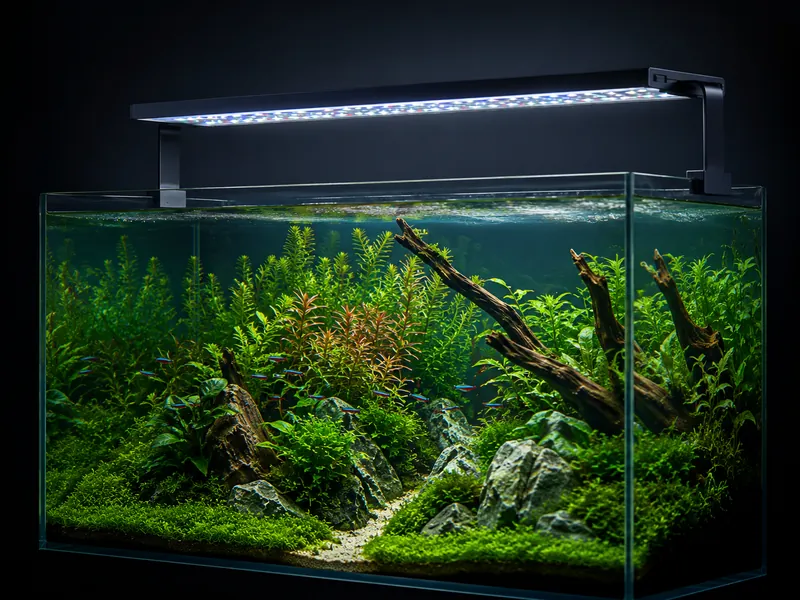
A rimless tank has no frame or brace around the top edge, so the clip-on lights and drop-in lids made for framed tanks usually have nothing to grip. Rimless owners generally use one of four routes: a bracket that attaches to the glass, a light hung from above, a light on risers or arms behind the tank, or a lid made for rimless glass. Pick the route before you buy the light, because the mounting decides what fits.
A framed tank has a plastic or metal rim around the top. Hoods sit on that rim, clip-on lights hook over it and lids rest on its ledge. A rimless tank has bare glass edges. A retailer's page on leveling mats describes rimless tanks as resting directly on top of the stand, in contrast with trimmed tanks, and the same bare-edge construction explains the top. There is simply no ledge to rest anything on.
That changes the shopping list in three ways. Lights need a mount that clamps to the glass, hangs from above, or stands on its own. Lids need clips, a frame that sits inside or on the glass edges, or a cut-to-fit panel. And everything on the top edge adds weight to glass that was not designed to carry much, so check each part's limits. Our mesh versus glass lids guide covers the lid side before the rimless detail.
There are four common ways to mount a light, and each has a trade-off.
Whatever the route, check the light's manual for its recommended height above the water and its heat guidance. Our LED light guide covers choosing a light itself, so settle the mounting before you pick on features.
Check the listing for the glass thickness it supports, the weight of the light it carries and whether it matches your light's model.
A caliper measures the glass edge accurately. Measure in a couple of places on the top rim and compare it with the mount's listed range.
Your options depend on whether you need to keep fish in, keep other things out, reduce evaporation or all three.
Check cord and tube cutouts early. Heaters, filters and airlines all need a way in and out. A solid lid with no cutouts invites you to leave a gap, so measure what must pass through and choose a lid with notches or a cover you can trim.
A rimless tank sits directly on its stand, so a level, even stand top matters more than usual. The same is true of anything added on top, because an uneven load on bare glass edges is harder to spread. Our guide to foam pads and leveling mats explains when a mat helps and why the tank maker's manual comes first. Read the tank's own instructions on whether anything may rest on the glass edges, and ask the maker if the manual does not say.
Take extra care when you work around glass edges. Corners are sharp, polished edges can still chip, and a dropped bracket can crack a top edge. Fit mounts with the tank empty of tools and helpers in the way, and get a second person for any lid larger than you can hold with one hand.
For most rimless tanks, a tank-specific light mount or a hanging kit paired with a clipped glass lid or a cut-to-fit cover covers the job. Start with the measurements, then check each listing for the thickness range, weight rating and tank sizes it names. If the listing does not say, assume it is not tested for your tank and ask the seller.
Match the clip's stated thickness range to your measured glass edge. Check the lid material the clip is meant to hold.
Usually not, because clip-on lights grip a rim that rimless tanks do not have. Look for a bracket made for rimless glass, a hanging kit or a riser.
Options include glass lids held by clips, mesh covers with hangers, and cut-to-fit panels. Check each listing for the glass thickness and tank size it supports.
That depends on the tank, the animals and the room. Read the tank's manual and our lid guides before deciding, and plan for cord and tube cutouts if you use one.
Use a caliper on the top edge of the glass in more than one spot and compare the reading with the mount's listed range. Check the manual or ask the maker if you are unsure.
Many rimless tanks do, but the maker's manual decides. A mat is not a cure for an uneven stand, so level the stand first.
Rimless fit varies by tank and by mount, so this guide quotes no thickness limits, weight ratings or heat figures. Check each product page and your tank's manual for those.
Heads-up: AquariumSetup.co participates in the Amazon Associates and eBay Partner Network programs. We may earn a commission on qualifying purchases at no extra cost to you. We only recommend gear we believe is genuinely useful to beginners.