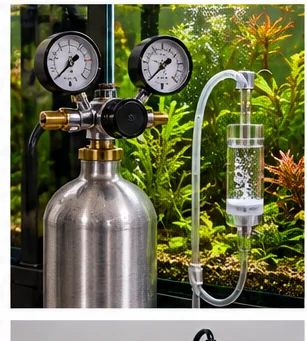
Products and configurations to compare
Inline CO2 diffuser atomizer
Fine mist through return.
Best when: canister-filter planted tanks
Watch for: hose diameter and leak prevention matter
In-tank ceramic diffuser
Easy to inspect.
Best when: small/medium planted tanks
Watch for: visible hardware and regular cleaning
CO2 drop checker + solution
Useful alongside pH/livestock observation.
Best when: you want a slow visual reference
Watch for: lags real-time concentration
Inline can add back pressure
Watch canister output after installation.
Hose diameter must match exactly
Adapters add leak points.
Ceramic discs clog
Bleach/cleaning routines must be followed carefully and rinsed completely.
Mist distribution follows return flow
Good circulation improves dissolved CO₂ distribution.
A diffuser cannot fix poor surface balance
Too much agitation can still waste gas.
CO2 consistency matters more than chasing bubbles per second
Bubble count is only a rough repeatable setting for one specific regulator, bubble counter and diffuser. Plant response, pH drop, drop-checker color and livestock behavior are better indicators. The equipment goal is stable delivery that turns on before the photoperiod and shuts off reliably before lights go dark.
Inline diffusers keep equipment out of the display and can produce fine mist through the return line, but they add plumbing connections and back pressure. In-tank diffusers are simpler and easier to inspect but need cleaning and can be visually distracting.
Every pressurized system needs a safe chain
Tank, regulator, solenoid, needle valve, bubble counter, check valve and diffuser each solve a distinct problem. Secure cylinders upright, use CO2-rated tubing and keep check valves oriented correctly so water cannot siphon back toward the regulator.
Before checkout
- Exact tank volume and livestock needs are known
- Equipment rating matches freshwater, saltwater or reef use
- Combined electrical load fits the outlet/controller
- Every cord has a drip loop and dry connection point
- Waterproof does not get assumed from 'splash resistant'
- Pump flow is evaluated after head height and restriction
- Replacement media, tubing, probes or bulbs are available
- Automation has a manual fallback
- Leak and siphon paths are considered
- The upgrade solves a specific maintenance or stability problem
Buy reliability before another feature
Aquarium gear becomes expensive when each item is judged alone. The better question is what failure or maintenance task costs the tank the most stability. A spare air pump may be more valuable than another smart light. A hose brush can restore more filtration than a new media pouch. A small leak sensor can matter more than a dashboard nobody checks.
Write the problem in one sentence: “the canister flow falls every month,” “I miss fertilizer doses,” “the reef overheats if a heater sticks,” or “I travel and cannot see whether the feeder dispensed.” Buy for that sentence rather than for the feature list.
Commission every automated device
Run new automation while you are home. Force the heater controller through its setpoint, intentionally lift the ATO sensor, measure dosing output into a graduated cylinder, trigger the leak sensor, and run the feeder with the exact food for several days. Automation should reduce uncertainty, not hide it.
Document calibration date, bulb date, tube size, replacement media part number and spare location. The aquarium becomes easier to own when the next maintenance job does not require rediscovering the system.
Frequently asked questions
Which dissolves more CO2?
Well-designed inline systems can improve contact time, but total system tuning matters.
Can inline leak?
Any added hose fitting can leak if poorly installed.
Which is easier to clean?
In-tank diffusers are easier to remove and inspect.
Best for nano tank?
In-tank is usually simpler.
Affiliate disclosure: AquariumSetup.co is an Amazon Associate and may also earn through eBay Partner Network links at no extra cost to you. Amazon links use scouttheory-20; eBay links use campaign 5339137014.