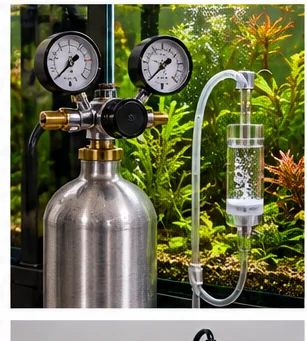
Products and configurations to compare
Dual-stage CO2 regulator with solenoid
Stable pressure plus automatic shutoff.
Best when: you run pressurized CO₂
Watch for: quality and cylinder thread compatibility matter
Smart plug/timer
Simple automation.
Best when: you want repeatable daily control
Watch for: Wi-Fi/cloud dependency on smart models
CO2-rated check valve + tubing
Prevents siphoning toward regulator.
Best when: regulator sits below tank waterline
Watch for: cheap valves can leak
Normally closed is safer
Power loss closes the gas path.
Start with conservative injection
Increase slowly while observing livestock.
Use pH trend as a stronger metric than bubble count
Bubble counters only repeat one setup.
Keep cylinder upright and secured
Pressurized cylinders deserve physical stability.
Inspect connections with appropriate leak-check method
Gas leaks waste CO₂ and can empty cylinders quickly.
CO2 consistency matters more than chasing bubbles per second
Bubble count is only a rough repeatable setting for one specific regulator, bubble counter and diffuser. Plant response, pH drop, drop-checker color and livestock behavior are better indicators. The equipment goal is stable delivery that turns on before the photoperiod and shuts off reliably before lights go dark.
Inline diffusers keep equipment out of the display and can produce fine mist through the return line, but they add plumbing connections and back pressure. In-tank diffusers are simpler and easier to inspect but need cleaning and can be visually distracting.
Every pressurized system needs a safe chain
Tank, regulator, solenoid, needle valve, bubble counter, check valve and diffuser each solve a distinct problem. Secure cylinders upright, use CO2-rated tubing and keep check valves oriented correctly so water cannot siphon back toward the regulator.
Before checkout
- Exact tank volume and livestock needs are known
- Equipment rating matches freshwater, saltwater or reef use
- Combined electrical load fits the outlet/controller
- Every cord has a drip loop and dry connection point
- Waterproof does not get assumed from 'splash resistant'
- Pump flow is evaluated after head height and restriction
- Replacement media, tubing, probes or bulbs are available
- Automation has a manual fallback
- Leak and siphon paths are considered
- The upgrade solves a specific maintenance or stability problem
Buy reliability before another feature
Aquarium gear becomes expensive when each item is judged alone. The better question is what failure or maintenance task costs the tank the most stability. A spare air pump may be more valuable than another smart light. A hose brush can restore more filtration than a new media pouch. A small leak sensor can matter more than a dashboard nobody checks.
Write the problem in one sentence: “the canister flow falls every month,” “I miss fertilizer doses,” “the reef overheats if a heater sticks,” or “I travel and cannot see whether the feeder dispensed.” Buy for that sentence rather than for the feature list.
Commission every automated device
Run new automation while you are home. Force the heater controller through its setpoint, intentionally lift the ATO sensor, measure dosing output into a graduated cylinder, trigger the leak sensor, and run the feeder with the exact food for several days. Automation should reduce uncertainty, not hide it.
Document calibration date, bulb date, tube size, replacement media part number and spare location. The aquarium becomes easier to own when the next maintenance job does not require rediscovering the system.
Frequently asked questions
How early should CO2 start?
Tune to the time needed for your tank to reach stable concentration before lights.
Should it run at night?
Usually no in typical planted-tank schedules.
Can I use any tubing?
Use tubing suitable for pressurized CO₂.
Do I need a check valve?
Strongly recommended when water could siphon back.
Affiliate disclosure: AquariumSetup.co is an Amazon Associate and may also earn through eBay Partner Network links at no extra cost to you. Amazon links use scouttheory-20; eBay links use campaign 5339137014.