Products and configurations to compare
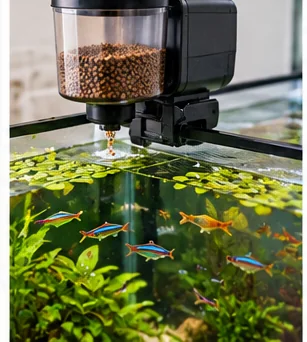
EHEIM autofeeder
Air movement helps keep food dry.
Best when: flake/granule feeders near open tanks
Watch for: small capacity
Moisture-resistant smart feeder
Dedicated drying/moisture features.
Best when: high-humidity room
Watch for: smart features add complexity
Feeder ring
Keeps portions where fish can reach them.
Best when: surface current pushes food into overflow
Watch for: needs correct placement
Never fill a dirty damp drum
Start with dry equipment.
Avoid splash zones
Filter returns and airstones can mist feeder openings.
Do not add loose desiccant unless the design safely isolates it from food
Food contamination risk matters.
Use pellets when possible
Uniform dry pellets generally meter more consistently than irregular flakes.
Simulate the trip
Run the feeder unattended while you are still home.
Automatic feeders fail through moisture before they fail through programming
Dry food clumps when humid aquarium air reaches the drum. EHEIM's current autofeeder uses an actively aerated chamber; Hygger also sells moisture-conscious feeder designs. Position the feeder so the food drops freely without the drum sitting directly over an open humid plume from a filter return.
Test portion size for several days before travel. One accidental overfeed can create more ammonia than a healthy aquarium processes comfortably, while fish generally tolerate a missed meal better than a massive feed dump.
Food type matters
Large pellets, fine granules and flakes meter differently through the same opening. Calibrate using the exact food you will leave in the feeder, and do not assume the same setting works after changing brands.
Before checkout
- Exact tank volume and livestock needs are known
- Equipment rating matches freshwater, saltwater or reef use
- Combined electrical load fits the outlet/controller
- Every cord has a drip loop and dry connection point
- Waterproof does not get assumed from 'splash resistant'
- Pump flow is evaluated after head height and restriction
- Replacement media, tubing, probes or bulbs are available
- Automation has a manual fallback
- Leak and siphon paths are considered
- The upgrade solves a specific maintenance or stability problem
Buy reliability before another feature
Aquarium gear becomes expensive when each item is judged alone. The better question is what failure or maintenance task costs the tank the most stability. A spare air pump may be more valuable than another smart light. A hose brush can restore more filtration than a new media pouch. A small leak sensor can matter more than a dashboard nobody checks.
Write the problem in one sentence: “the canister flow falls every month,” “I miss fertilizer doses,” “the reef overheats if a heater sticks,” or “I travel and cannot see whether the feeder dispensed.” Buy for that sentence rather than for the feature list.
Commission every automated device
Run new automation while you are home. Force the heater controller through its setpoint, intentionally lift the ATO sensor, measure dosing output into a graduated cylinder, trigger the leak sensor, and run the feeder with the exact food for several days. Automation should reduce uncertainty, not hide it.
Document calibration date, bulb date, tube size, replacement media part number and spare location. The aquarium becomes easier to own when the next maintenance job does not require rediscovering the system.
Frequently asked questions
Can I use flakes?
Yes in compatible feeders, but clumping risk is higher.
Should I refrigerate food?
Not inside ordinary feeders; use dry stable food.
Can I cover the feeder?
Do not block ventilation or motor operation.
How long should I test?
Several days to a week with the exact food/portion schedule.
Current product/source checks
Affiliate disclosure: AquariumSetup.co is an Amazon Associate and may also earn through eBay Partner Network links at no extra cost to you. Amazon links use scouttheory-20; eBay links use campaign 5339137014.