Air stone assortment
StarterA mixed pack lets you test sizes. Check the airline fitting on the stone and match it to your tubing.
Reader-supported: some links on this page are affiliate links. As an Amazon Associate I earn from qualifying purchases, at no extra cost to you.
Pick by the effect you want and by what your pump can push. Stones, wands and discs all run on the same airline, so pump output and depth set the limit.
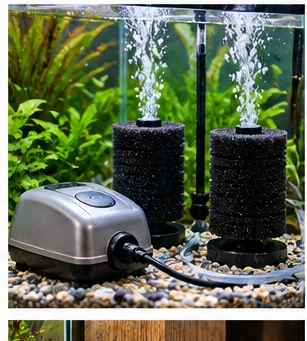
Choose by the effect you want and by what your air pump can push. A stone is the simple all-round pick, a bubble wand (a bar or flexible strip) spreads air along a length of the tank, and a disc covers a wide area from one spot on the bottom. All three run on the same airline, so the real limit is your pump's output and the water depth, not the shape of the accessory.
An air accessory has one job, which is to break the air from the pump into bubbles. How it does that affects the look, the sound and how long it lasts.
Our quiet air pump guide notes the trade-off that applies across all of them: fine-pore diffusers look appealing but clog faster and tend to hiss, while coarser ones are less showy and quieter. That is the pattern to expect from the pore size, whatever the shape.
| Accessory | Best for | Watch for |
|---|---|---|
| Air stone | Small tanks, sponge filters, a single point of aeration | Pores clog over time; a fine stone may need more pump pressure |
| Bubble wand or bar | Long tanks, a back-wall curtain, spreading air across a width | Needs a pump that can feed the whole length; a short airline can pull it off the glass |
| Disc diffuser | Even bubbles over a wider patch from one spot | Needs a flat resting place; a weak pump may only feed part of the disc |
Notice that none of these says "quiet". Noise comes from the pump, the tubing and where they rest, not just from the diffuser. If your tank is in a bedroom, solve the pump first, then choose the accessory.
Placement changes both the look and the sound. Set a stone or disc on the bottom, clear of decor that could trap it, and keep the airline from pulling it sideways. Mount a wand along the back glass or the bottom front edge, where the curtain reads clearly, and make sure it is held down so it cannot rise as it fills with air. Keep every diffuser away from the heater cord and the filter intake, so the lines do not tangle or get sucked against the intake.
Leave a loop of slack in the airline between the pump and the first suction cup. A taut line carries vibration to the glass and tends to buzz. Also keep the pump itself above the water line or behind a check valve, so a power cut cannot send water down the tube.
A mixed pack lets you test sizes. Check the airline fitting on the stone and match it to your tubing.
Measure the length of the glass you want to cover and check the listing for the airline inlet position and how it mounts.
Air pumps are rated on their label, and water depth pushes back against the air. A deeper tank asks more of the pump, and a very fine diffuser asks more again. If the bubbles from a new wand are weak at one end, the pump may be too small for its length, or the airline may be kinked, or the diffuser may be partly clogged.
Before you buy, work through these checks:
The parts between the pump and the diffuser decide whether the system works.
All porous diffusers wear. Minerals and fine debris block the pores, the bubble stream thins and the pump works harder. Signs include a weaker or uneven stream, bubbles from only part of a wand, and more noise from the pump. The fix is usually to replace the diffuser, which is inexpensive. Some makers describe cleaning methods in the package instructions, and those are worth following, since methods that suit one material may damage another.
Keep a spare diffuser and a short length of spare tubing with your tank gear. They cost little, take up almost no space and fix the most common air-system failures. Our quiet air pump guide adds tips on reducing pump noise. If a rattle or hum is the real problem, the fix is often the pump's resting place or the tubing, not the diffuser.
Buy tubing that matches your pump nozzle and diffuser inlet, and add a check valve in the right direction.
An air stone makes a column of bubbles from one point. A bubble wand or bar spreads air along a length of tank, so it makes a curtain. Both need an air pump and airline tubing.
Match the pump to the accessory using the output rating on the pump's label. Deeper water and finer diffusers need more from the pump, so check the maker's guidance for both.
The usual causes are a pump that is too small for the length, a kinked or loose airline, or a partly clogged diffuser. Check the tubing first, then the diffuser, then the pump's rating.
There is no fixed interval. Replace it when the bubble stream thins or turns uneven, or when the pump labors. Keep a spare on hand.
Often yes, especially if the pump sits below the water line, because it stops water from running back down the line. Check the direction arrow when you fit it.
This is a general equipment comparison. No pump output figures, depth limits or replacement intervals are quoted, because they differ by pump and diffuser; read your pump's label and manual for those. Statements about fine-pore diffusers clogging faster and hissing more follow our own quiet air pump guide.
Heads-up: AquariumSetup.co participates in the Amazon Associates and eBay Partner Network programs. We may earn a commission on qualifying purchases at no extra cost to you. We only recommend gear we believe is genuinely useful to beginners.