Products and configurations to compare
Battery aquarium air pump
Tiny load, simple purpose.
Best when: freshwater and emergency backup
Watch for: replace batteries periodically
USB rechargeable air pump
Flexible low-watt backup.
Best when: you keep large charged power banks
Watch for: battery state needs monitoring
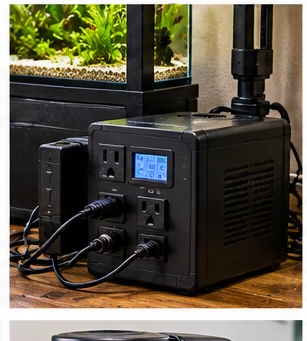
Pure sine UPS
Good for selected electronics.
Best when: you need a small return/powerhead running
Watch for: runtime collapses with high loads
Calculate load, not VA marketing
Actual watts determine runtime.
Air stones need placement
One at each end can improve broad gas exchange.
Warm water holds less oxygen
Summer outages can become urgent faster.
Insulate in cold outages
Blankets around the glass can slow cooling without using electricity.
Test automatic transfer
A UPS is only useful if the connected pump actually restarts correctly.
During an outage, oxygen is usually the first priority
In many stocked aquariums, circulation and gas exchange become critical before filtration chemistry. Battery air pumps, USB air pumps on power banks and a small UPS for selected circulation can buy time. Running a large heater from a consumer UPS drains capacity rapidly compared with running a small air pump.
Plan by watts and hours. A device that draws 5W can run roughly twenty times longer than a 100W device from the same idealized battery capacity, before conversion losses. That is why outage plans often prioritize aeration and circulation, then insulation/room heat for temperature.
Test backup systems before livestock depends on them
Battery corrosion, dead power banks and stuck check valves are common preventable failures. Run the backup air pump for an hour every few months and replace aging disposable batteries before storm season.
Before checkout
- Exact tank volume and livestock needs are known
- Equipment rating matches freshwater, saltwater or reef use
- Combined electrical load fits the outlet/controller
- Every cord has a drip loop and dry connection point
- Waterproof does not get assumed from 'splash resistant'
- Pump flow is evaluated after head height and restriction
- Replacement media, tubing, probes or bulbs are available
- Automation has a manual fallback
- Leak and siphon paths are considered
- The upgrade solves a specific maintenance or stability problem
Buy reliability before another feature
Aquarium gear becomes expensive when each item is judged alone. The better question is what failure or maintenance task costs the tank the most stability. A spare air pump may be more valuable than another smart light. A hose brush can restore more filtration than a new media pouch. A small leak sensor can matter more than a dashboard nobody checks.
Write the problem in one sentence: “the canister flow falls every month,” “I miss fertilizer doses,” “the reef overheats if a heater sticks,” or “I travel and cannot see whether the feeder dispensed.” Buy for that sentence rather than for the feature list.
Commission every automated device
Run new automation while you are home. Force the heater controller through its setpoint, intentionally lift the ATO sensor, measure dosing output into a graduated cylinder, trigger the leak sensor, and run the feeder with the exact food for several days. Automation should reduce uncertainty, not hide it.
Document calibration date, bulb date, tube size, replacement media part number and spare location. The aquarium becomes easier to own when the next maintenance job does not require rediscovering the system.
Frequently asked questions
Can UPS run a heater?
Technically yes, but runtime may be very short because heaters draw far more power.
What should run first?
Usually aeration/circulation.
Does filter bacteria die immediately?
No, but stagnant oxygen-poor media degrades over time.
Best cheap backup?
A tested battery air pump with fresh batteries.
Current product/source checks
Affiliate disclosure: AquariumSetup.co is an Amazon Associate and may also earn through eBay Partner Network links at no extra cost to you. Amazon links use scouttheory-20; eBay links use campaign 5339137014.