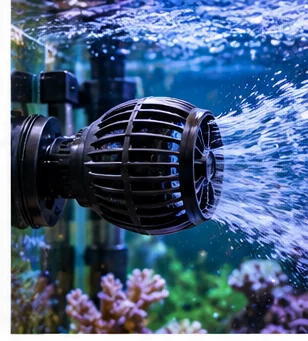
Products and configurations to compare
AI Nero 3
2,000 GPH in a small body.
Best when: nano/medium systems
Watch for: less headroom in long SPS tanks
AI Nero 5
3,000 GPH maximum.
Best when: 40–100+ gallon reefs
Watch for: larger footprint and more flow to tame
Nero fish/anemone guard
Cheap pump-intake insurance.
Best when: small fish or wandering anemones
Watch for: guard needs cleaning
Tank length matters more than gallons
A long shallow reef may need two pumps sooner than a cube.
Two smaller pumps can beat one large pump
Opposing or alternating patterns improve coverage.
Coral type changes target flow
SPS usually wants more energetic random flow than many softies.
Glass thickness matters for magnets
AI lists different maximum glass thicknesses for the two models.
Clean guards and rotors regularly
Flow loss creeps in gradually.
Flow should move water without beating up livestock
Reef tanks need enough broad circulation to keep detritus suspended and deliver oxygen/nutrients, but raw GPH is not a livestock goal. A compact pump at high output can create a harsh jet while a larger cross-flow pattern moves more total water gently. Placement, pulse pattern and rockwork matter as much as the number on the box.
AI's current Nero 3 is rated to 2,000 GPH and Nero 5 to 3,000 GPH. The smaller pump is easier to hide and is often sufficient in nano/medium systems; the larger pump earns its space when tank dimensions and coral demand actually need it.
Guards are livestock protection
Anemones, small fish and snails can reach pump intakes. Manufacturer or well-fitted guards are cheap compared with livestock loss. Guards also reduce open intake area, so they need regular cleaning before flow falls off.
Before checkout
- Exact tank volume and livestock needs are known
- Equipment rating matches freshwater, saltwater or reef use
- Combined electrical load fits the outlet/controller
- Every cord has a drip loop and dry connection point
- Waterproof does not get assumed from 'splash resistant'
- Pump flow is evaluated after head height and restriction
- Replacement media, tubing, probes or bulbs are available
- Automation has a manual fallback
- Leak and siphon paths are considered
- The upgrade solves a specific maintenance or stability problem
Buy reliability before another feature
Aquarium gear becomes expensive when each item is judged alone. The better question is what failure or maintenance task costs the tank the most stability. A spare air pump may be more valuable than another smart light. A hose brush can restore more filtration than a new media pouch. A small leak sensor can matter more than a dashboard nobody checks.
Write the problem in one sentence: “the canister flow falls every month,” “I miss fertilizer doses,” “the reef overheats if a heater sticks,” or “I travel and cannot see whether the feeder dispensed.” Buy for that sentence rather than for the feature list.
Commission every automated device
Run new automation while you are home. Force the heater controller through its setpoint, intentionally lift the ATO sensor, measure dosing output into a graduated cylinder, trigger the leak sensor, and run the feeder with the exact food for several days. Automation should reduce uncertainty, not hide it.
Document calibration date, bulb date, tube size, replacement media part number and spare location. The aquarium becomes easier to own when the next maintenance job does not require rediscovering the system.
Frequently asked questions
Nero 3 max flow?
2,000 GPH.
Nero 5?
3,000 GPH.
Which for 40 gallon breeder?
Either can work; Nero 3 often has enough flow, while Nero 5 offers more headroom.
Do I need two?
For complex rockwork, two lower-output pumps often improve coverage.
Current product/source checks
Affiliate disclosure: AquariumSetup.co is an Amazon Associate and may also earn through eBay Partner Network links at no extra cost to you. Amazon links use scouttheory-20; eBay links use campaign 5339137014.