Products and configurations to compare
Coralife Turbo-Twist replacement lamp
Scheduled maintenance item.
Best when: you run UV continuously
Watch for: exact watt/model must match
UV quartz sleeve
Clean surface is critical.
Best when: sleeve is cloudy or damaged
Watch for: fragile glass/quartz
UV sleeve cleaning brush / citric acid kit
Restores transmission.
Best when: mineral film accumulates
Watch for: follow manufacturer-safe cleaning chemistry
Write the bulb date on the unit
Calendar memory is unreliable.
Power down before opening
UV lamps and water plumbing require safe service.
Do not touch clean lamps/sleeves with oily fingers
Use clean gloves or cloth.
Inspect O-rings
A reopened UV chamber is another leak point.
Prime/purge air before restart
Follow the exact unit instructions.
UV performance depends on flow and maintenance
A UV sterilizer only treats water that passes through the chamber, and contact time changes with flow rate. Manufacturers size different units for clarification or microorganism control under specific flow conditions. Slower flow generally increases exposure per pass, while excessive flow can turn a powerful UV into little more than an expensive illuminated tube.
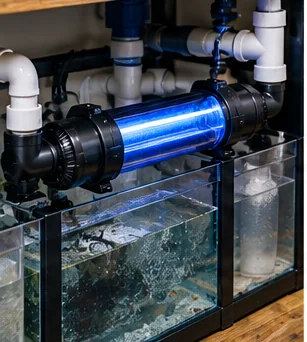
Coralife's current Turbo-Twist uses a twist-flow chamber, can be hung or installed inline, and requires a separate pump. The quartz sleeve and bulb are maintenance items; a lamp can still glow after useful UV-C output has declined.
UV is not a cure-all
It does not remove ammonia, nitrate, detritus or organisms attached to fish, rock or substrate. Treat it as one water-column management tool alongside quarantine, husbandry and filtration.
Before checkout
- Exact tank volume and livestock needs are known
- Equipment rating matches freshwater, saltwater or reef use
- Combined electrical load fits the outlet/controller
- Every cord has a drip loop and dry connection point
- Waterproof does not get assumed from 'splash resistant'
- Pump flow is evaluated after head height and restriction
- Replacement media, tubing, probes or bulbs are available
- Automation has a manual fallback
- Leak and siphon paths are considered
- The upgrade solves a specific maintenance or stability problem
Buy reliability before another feature
Aquarium gear becomes expensive when each item is judged alone. The better question is what failure or maintenance task costs the tank the most stability. A spare air pump may be more valuable than another smart light. A hose brush can restore more filtration than a new media pouch. A small leak sensor can matter more than a dashboard nobody checks.
Write the problem in one sentence: “the canister flow falls every month,” “I miss fertilizer doses,” “the reef overheats if a heater sticks,” or “I travel and cannot see whether the feeder dispensed.” Buy for that sentence rather than for the feature list.
Commission every automated device
Run new automation while you are home. Force the heater controller through its setpoint, intentionally lift the ATO sensor, measure dosing output into a graduated cylinder, trigger the leak sensor, and run the feeder with the exact food for several days. Automation should reduce uncertainty, not hide it.
Document calibration date, bulb date, tube size, replacement media part number and spare location. The aquarium becomes easier to own when the next maintenance job does not require rediscovering the system.
Frequently asked questions
How often replace bulb?
Use the manufacturer interval for the exact lamp and duty cycle.
Can I tell by brightness?
No.
Can the sleeve be cleaned?
Yes when manufacturer guidance permits.
Should I keep a spare?
Useful when UV is part of an important treatment/clarification plan.
Current product/source checks
Affiliate disclosure: AquariumSetup.co is an Amazon Associate and may also earn through eBay Partner Network links at no extra cost to you. Amazon links use scouttheory-20; eBay links use campaign 5339137014.