Products and configurations to compare
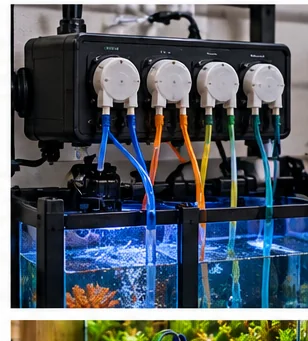
4-line dosing tube holder
Prevents tubes wandering onto the floor.
Best when: multiple supplements dose into sump
Watch for: mounting thickness must fit sump rim
Chemical-resistant check valves
Inspect regularly.
Best when: siphon risk exists
Watch for: some additives crystallize and foul valves
Dosing reservoir set
Clear volume tracking.
Best when: alk/cal/mag or multi-part dosing
Watch for: large reservoirs increase overdose volume if control fails
Dose high-flow areas
Avoid concentrated additive sitting on coral or heater surfaces.
Separate alk and calcium outlets
Directly mixing concentrates can precipitate.
Keep reservoir size reasonable
Automation failure risk scales with available volume.
Clean crystallized outlets
Alkalinity lines especially can clog.
Photograph routing
It makes troubleshooting much easier months later.
Dosing pumps automate repetition, not chemistry
A dosing pump can deliver alkalinity, calcium, magnesium, trace solutions or planted-tank fertilizer precisely on schedule, but it cannot tell whether the aquarium actually needs the dose unless paired with testing or a broader controller system. Calibrate every pump head with the tubing and container arrangement you will actually use.
Hygger's current four-channel pump supports independent control, up to 24 doses per day and a listed maximum flow of 55 ml/min, with ±10% precision in its published specifications. That is sufficient for many hobby dosing jobs, but the calibration step is not optional.
Line management prevents expensive accidents
Keep dosing outlets above the waterline or use appropriate anti-siphon/check-valve design, separate lines so incompatible concentrates cannot mix in tubing, and secure ends so a maintenance bump cannot move a line out of the sump and onto the floor.
Before checkout
- Exact tank volume and livestock needs are known
- Equipment rating matches freshwater, saltwater or reef use
- Combined electrical load fits the outlet/controller
- Every cord has a drip loop and dry connection point
- Waterproof does not get assumed from 'splash resistant'
- Pump flow is evaluated after head height and restriction
- Replacement media, tubing, probes or bulbs are available
- Automation has a manual fallback
- Leak and siphon paths are considered
- The upgrade solves a specific maintenance or stability problem
Buy reliability before another feature
Aquarium gear becomes expensive when each item is judged alone. The better question is what failure or maintenance task costs the tank the most stability. A spare air pump may be more valuable than another smart light. A hose brush can restore more filtration than a new media pouch. A small leak sensor can matter more than a dashboard nobody checks.
Write the problem in one sentence: “the canister flow falls every month,” “I miss fertilizer doses,” “the reef overheats if a heater sticks,” or “I travel and cannot see whether the feeder dispensed.” Buy for that sentence rather than for the feature list.
Commission every automated device
Run new automation while you are home. Force the heater controller through its setpoint, intentionally lift the ATO sensor, measure dosing output into a graduated cylinder, trigger the leak sensor, and run the feeder with the exact food for several days. Automation should reduce uncertainty, not hide it.
Document calibration date, bulb date, tube size, replacement media part number and spare location. The aquarium becomes easier to own when the next maintenance job does not require rediscovering the system.
Frequently asked questions
Do I always need check valves?
No; correct outlet height and tubing layout may be safer/simpler.
Can dosing lines sit underwater?
That can create siphon/backflow risk depending on setup.
How far apart should outlets be?
Far enough that concentrated incompatible additives do not immediately mix.
Should reservoirs be huge?
Not unless the control system and risk justify it.
Current product/source checks
Affiliate disclosure: AquariumSetup.co is an Amazon Associate and may also earn through eBay Partner Network links at no extra cost to you. Amazon links use scouttheory-20; eBay links use campaign 5339137014.