Products and configurations to compare
Canister spray bar kit
Easy to aim and distribute flow.
Best when: community tanks and long aquariums
Watch for: hole size and hose diameter must match
Glass lily pipe set
Classic aquascape look.
Best when: appearance and smooth circulation matter
Watch for: fragile and needs frequent cleaning
Stainless lily pipe set
Easier handling than glass.
Best when: you like lily-pipe flow without fragile glass
Watch for: higher cost and visible hardware
Outlet height controls agitation
Raise toward surface for oxygenation, lower for calmer CO₂ retention.
Spray-bar hole orientation is tunable
Front glass, surface or rear wall all create different loops.
Lily pipes create a broad vortex-style pattern
Excellent in open planted layouts.
Glass reveals biofilm quickly
That is aesthetically annoying but useful maintenance feedback.
Do not chase zero surface movement
Fish still need gas exchange.
Filtration upgrades should target maintenance, not headline flow
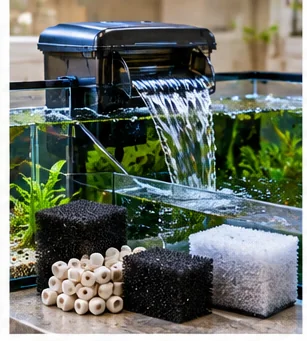
Filters are often sold by pump GPH, but the useful output is filtered circulation after baskets, media, hose rise and maintenance losses. Fluval's current 407 is a perfect example: the pump output is listed at 383 GPH while filter circulation is 245 GPH. That gap is normal. More important is whether the filter holds enough mechanical and biological media and whether you can service it without turning maintenance into a two-hour project.
The best upgrades often live around the filter rather than inside it: a coarse prefilter to catch plant debris, better hose routing, quick-disconnect valves, a spray bar that distributes flow more evenly, or a cleaning brush long enough to reach the full hose run.
Do not replace biological media casually
Mechanical pads can be cleaned or replaced on a schedule. Biological media should generally be preserved and rinsed in dechlorinated or tank water when needed so you do not remove a large portion of established nitrifying bacteria at once. Chemical media is purpose-driven rather than mandatory.
Before checkout
- Exact tank volume and livestock needs are known
- Equipment rating matches freshwater, saltwater or reef use
- Combined electrical load fits the outlet/controller
- Every cord has a drip loop and dry connection point
- Waterproof does not get assumed from 'splash resistant'
- Pump flow is evaluated after head height and restriction
- Replacement media, tubing, probes or bulbs are available
- Automation has a manual fallback
- Leak and siphon paths are considered
- The upgrade solves a specific maintenance or stability problem
Buy reliability before another feature
Aquarium gear becomes expensive when each item is judged alone. The better question is what failure or maintenance task costs the tank the most stability. A spare air pump may be more valuable than another smart light. A hose brush can restore more filtration than a new media pouch. A small leak sensor can matter more than a dashboard nobody checks.
Write the problem in one sentence: “the canister flow falls every month,” “I miss fertilizer doses,” “the reef overheats if a heater sticks,” or “I travel and cannot see whether the feeder dispensed.” Buy for that sentence rather than for the feature list.
Commission every automated device
Run new automation while you are home. Force the heater controller through its setpoint, intentionally lift the ATO sensor, measure dosing output into a graduated cylinder, trigger the leak sensor, and run the feeder with the exact food for several days. Automation should reduce uncertainty, not hide it.
Document calibration date, bulb date, tube size, replacement media part number and spare location. The aquarium becomes easier to own when the next maintenance job does not require rediscovering the system.
Frequently asked questions
Which is better for CO₂?
Either can work; tune surface agitation rather than choosing by name.
Which is quieter?
Both can be nearly silent when submerged correctly.
Can spray bars reduce current?
They distribute the same flow across multiple outlets.
Are lily pipes safe for shrimp?
Use an intake guard where small livestock could enter.
Affiliate disclosure: AquariumSetup.co is an Amazon Associate and may also earn through eBay Partner Network links at no extra cost to you. Amazon links use scouttheory-20; eBay links use campaign 5339137014.