Products and configurations to compare
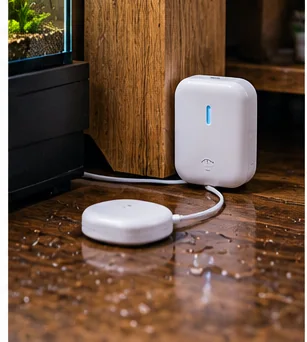
GoveeLife smart water leak sensor
Phone alert plus loud local alarm.
Best when: you travel or tank is on another floor
Watch for: gateway/app dependency
Standalone water leak alarm
Cheap under-canister protection.
Best when: someone is usually home
Watch for: no remote notification
Leak sensor rope/cable system
Detects along a line rather than one point.
Best when: large sump/cabinet footprint
Watch for: higher cost
Put sensors at first-failure locations
Canister valves, sump corners and ATO reservoir are prime candidates.
Test with a damp paper towel
Do not wait for a real leak to learn notification settings.
Raise power strips above floor level
Leak alarms should not be the only defense.
Use multiple sensors on large systems
One puck cannot cover every low point.
Replace batteries proactively
A dead leak sensor creates false confidence.
Water-management accessories prevent household damage
Aquariums put tens or hundreds of gallons above floors, power strips and cabinets. Leak sensors under canisters, sumps and ATO reservoirs are cheap early-warning devices. GoveeLife's current sensor platform supports app alerts through a gateway and lists IP67 sensors with a 105 dB alarm.
ATO systems deserve equal caution. The pump is small, but an unrestricted reservoir can still add far more freshwater than the aquarium should receive. Limit reservoir size, secure tubing, avoid siphon paths and test sensor failure behavior.
A leak alarm is not a substitute for plumbing
Use unions, clamps, correct hose/barb sizes and accessible shutoff valves. The sensor should catch an unexpected failure, not compensate for a fitting you already know is questionable.
Before checkout
- Exact tank volume and livestock needs are known
- Equipment rating matches freshwater, saltwater or reef use
- Combined electrical load fits the outlet/controller
- Every cord has a drip loop and dry connection point
- Waterproof does not get assumed from 'splash resistant'
- Pump flow is evaluated after head height and restriction
- Replacement media, tubing, probes or bulbs are available
- Automation has a manual fallback
- Leak and siphon paths are considered
- The upgrade solves a specific maintenance or stability problem
Buy reliability before another feature
Aquarium gear becomes expensive when each item is judged alone. The better question is what failure or maintenance task costs the tank the most stability. A spare air pump may be more valuable than another smart light. A hose brush can restore more filtration than a new media pouch. A small leak sensor can matter more than a dashboard nobody checks.
Write the problem in one sentence: “the canister flow falls every month,” “I miss fertilizer doses,” “the reef overheats if a heater sticks,” or “I travel and cannot see whether the feeder dispensed.” Buy for that sentence rather than for the feature list.
Commission every automated device
Run new automation while you are home. Force the heater controller through its setpoint, intentionally lift the ATO sensor, measure dosing output into a graduated cylinder, trigger the leak sensor, and run the feeder with the exact food for several days. Automation should reduce uncertainty, not hide it.
Document calibration date, bulb date, tube size, replacement media part number and spare location. The aquarium becomes easier to own when the next maintenance job does not require rediscovering the system.
Frequently asked questions
Where should sensor go?
At the lowest likely leak point under plumbing/equipment.
Can Govee send phone alerts?
Yes through its gateway/app setup.
Is it waterproof?
The current sensor is listed IP67.
Does it shut water off?
Not by itself unless integrated with a separate compatible shutoff system.
Current product/source checks
Affiliate disclosure: AquariumSetup.co is an Amazon Associate and may also earn through eBay Partner Network links at no extra cost to you. Amazon links use scouttheory-20; eBay links use campaign 5339137014.